Urinary Tract Infections
If you have been asked to fill out a UTI journal, please download it here:
Urinary tract infections (UTIs) affect your urinary tract, including your bladder (cystitis), urethra (urethritis) or kidneys (kidney infection). UTIs may be treated with antibiotics, but they're not always needed.
Symptoms of a urinary tract infection (UTI)
Symptoms of a urinary tract infection (UTI) may include:
- pain or a burning sensation when peeing (dysuria)
- needing to pee more often than usual
- needing to pee more often than usual during the night (nocturia)
- needing to pee suddenly or more urgently than usual
- pee that looks cloudy
- blood in your pee
- lower tummy pain or pain in your back, just under the ribs
- a high temperature, or feeling hot or cold, and shivery
- a very low temperature below 36C
- feeling tired or weak
Your pee may also be dark or smell. If this is your only symptom, it might be because you've not been drinking enough water.
Symptoms in children
Children with UTIs may also:
- have a high temperature – your child is feeling hotter than usual if you touch their neck, back or tummy
- appear generally unwell – babies and young children may be irritable and not feed, eat or drink properly
- wet the bed or wet themselves
- be sick
Symptoms in older, frail people or people with a urinary catheter
In older, frail people who have problems with memory, learning and concentration (such as dementia), and people with a urinary catheter, symptoms of a UTI may also include:
- changes in behaviour, such as acting agitated or confused (delirium)
- leaking pee (wetting themselves or incontinence) that is worse than usual
- new shivering or shaking (rigors)
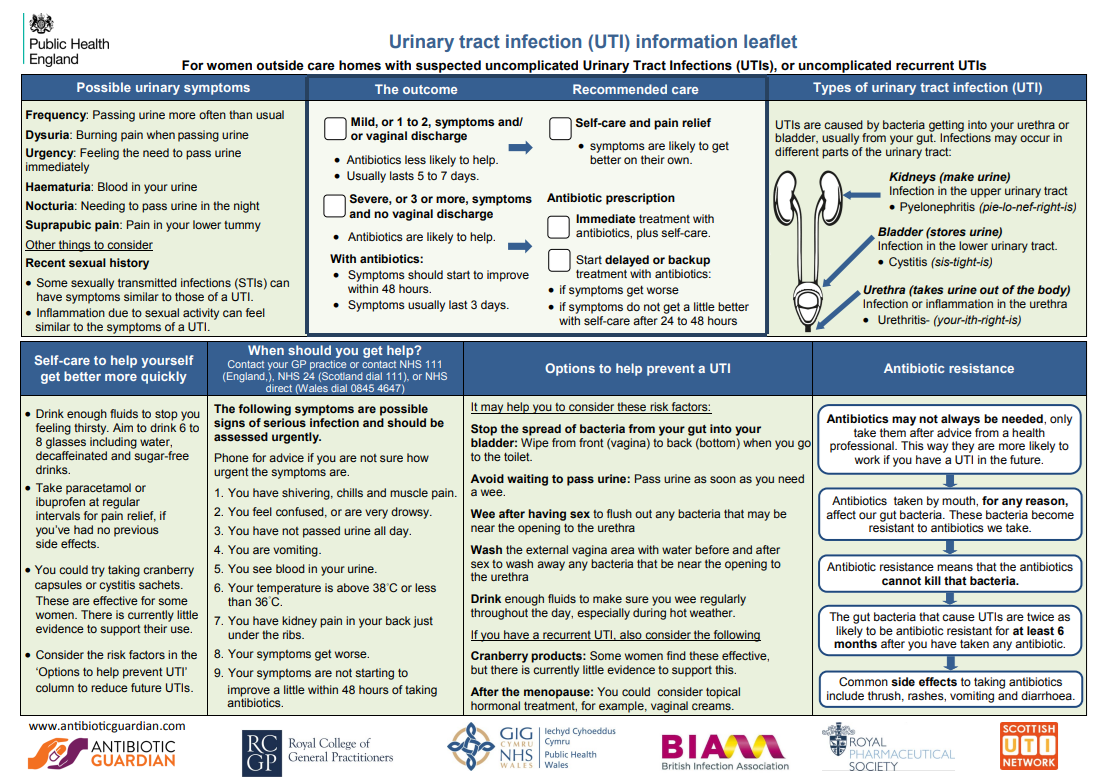
If your UTI comes back after treatment, or you have 2 UTIs in 6 months (or 3 within 12 months), you'll need to see a GP. They may: Sometimes UTI symptoms do not go away. Short-term antibiotics may not work and urine tests may not show an infection. This might mean you have a long-term (chronic) UTI. This can be caused by bacteria entering the lining of your bladder. Chronic UTIs can be difficult to diagnose because urine tests do not always pick up the infection and the symptoms can be similar to other conditions. Chronic UTIs might be treated with antibiotics you take for a long time. Chronic UTIs can have a big impact on your quality of life. If you have been treated for a UTI but you still have symptoms, speak to your GP and ask to be referred to a specialist.Treatment for UTIs that keep coming back (recurrent UTIs)
Long-term (chronic) UTIs
Other Information Leaflets
Page created: 12 January 2026